

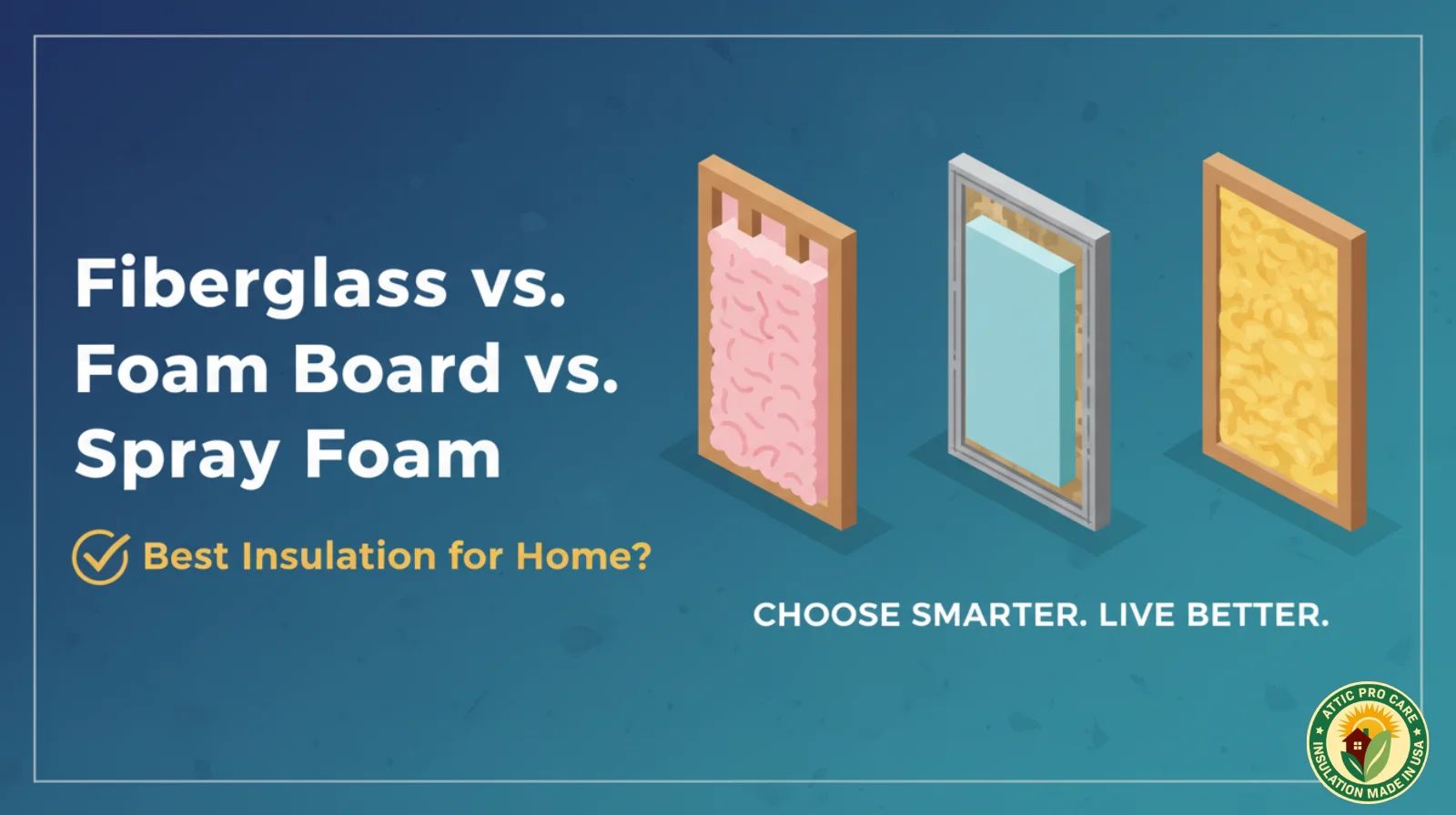
Fiberglass vs Foam Board vs Spray Foam: Best Insulation for Home
Published on December 25, 2025 | By Attic Pro Care, Inc
Selecting insulation for a home has a significant impact on comfort, energy costs, and the expenses in the long run. The residential market is dominated by three primary insulation types: fiberglass, foam board, and spray foam. They have some unique strengths, limitations, and best uses.
Their knowledge of material differences enables the homeowner and the builder to make informed choices that achieve reasonable costs, performance, and project requirements.
Fiberglass Insulation
Fiberglass insulation comprises fragile strands of glass woven to form batts or blown loose fine fill. Air is squeezed between the fibers in the material, forming thermal resistance. Fiberglass insulation is the most traditional kind of insulation manufactured by manufacturers for more than 80 years.
Available Forms
Fiberglass is available in pre-cut batts that match the standard wall stud spacing, rolls that are continuously installed, and loose fill that is blown into the attic or walls. The most significant type of new construction is the batts. Loose-fill suits are retrofit installations and are used at irregular locations.
Installation Process
Batt installation entails installing material between studs or joists. This process involves cutting to fit around obstacles and fully covering them. Loose fill will use special blowing equipment to distribute the material evenly. Both techniques are simple yet require attention to detail.
R-Value and Thermal Performance
Standard fiberglass batts range from R-13 to R-21 in thickness. Loose fill has R-30 to R-49 in the attic applications. The material becomes useless when compacted or when it gets wet. Correct installation is a key feature of advertised performance.
Cost Considerations
Fiberglass is the cheapest insulation material per square foot. Batts are approximately half the price of foam substitutes. Fiberglass is affordable and hence suitable for low-cost ventures. Average home costs range from a few thousand to several hundred thousand dollars in material costs.
Moisture Performance
Fiberglass has no water absorption, and the ability to insulate is lost when wet. The material dries quickly after moisture issues are resolved. Vapor barriers are necessary in humid weather.
Air Sealing Limitations
Fiberglass is not a good sealer of air gaps. The material does not block air, and the overall insulation performance is poor. Before fiberglass is installed, separate air sealing should be taken. This is another process that incurs labor and material expenses.
Durability and Lifespan
Fiberglass is durable and can be installed to last as long as a home. The substance does not degrade significantly over time. Effectiveness, however, can be reduced by pest disturbance or remodeling. This is because undisturbed installations last for decades.
Health and Safety Considerations
Fiberglass particles have affected the lungs, eyes, and skin during installation. Personal protective tools such as Masks, gloves, and long sleeves are necessary. The material is not dangerous health-wise once covered and installed. The current formulations lower formaldehyde levels compared to historical levels.
Environmental Impact
A fiberglass is composed of approximately 60 percent recycled glass. Manufacturing consumes much energy, but materials are recyclable. Production impact, the long lifespan, and energy savings are equal. Fiberglass is a comparatively sustainable solution.
Best Applications
Fiberglass is applicable in standard wall frames, floors, and attics. New buildings that have standard-sized cavities fit batts well. High R-values can be economically achieved through attic insulation with blown fiberglass. Where moisture control is handled independently, the material is excellent.
Limitations
Fiberglass must be installed with care, avoiding compression and leaving no gaps. The substance cannot block air leaks. In wet conditions, performance significantly reduces. Inaccessible areas and uneven surfaces are obstacles to proper installation.
Foam Board Insulation
Foam board is an insulation structure composed of rigid polystyrene, polyisocyanurate, or polyurethane boards. The solid panels offer insulation as well as structural rigidity. Manufacturers produce boards in standard foot sheets and thicknesses.
Types of Foam Board Insulation
Expanded polystyrene (EPS) is similar to the white foam coolers and is the least expensive. Extruded polystyrene (XPS) is pink or blue and more moisture-resistant. Polyisocyanurate (polyiso) has the best R-value per inch. All its types have a variety of applications.
Installation Methods
Foam boards can be easily cut with standard tools. Installation is done to cut down the panels and tune them closely to the framing, or to attach them to surfaces. Sewage needs to be taped or sealed to prevent air leaks. The inflexible one is easy to deal with, unlike flexible insulation.
R-Value Performance
EPS approximates R-4 throughout. XPS delivers R-5 per inch. Polyiso has the highest of the three with R-6 to R-6.5 per inch. Larger R in better R-value per inch to provide finer installations on space-limited applications.
Cost Analysis
Foam boards are more expensive than fiberglass but less expensive than spray foam. XPS and poly are more expensive than EPS. The prices of materials for insulating the entire house range from moderate to high. It has a more pronounced profile, which sometimes justifies the increased costs in constrained spaces.
Moisture Resistance
Foam boards take less moisture than fiberglass. Polyiso and XPS are very resistant to water. The materials retain R-value during wet conditions. This is a moisture tolerance applicable to high-humidity applications and below-grade environments.
Air Sealing Capabilities
Foam boards with the correct dimensions and well-sealed seams provide practical air barriers. This is because the hard material eradicates any air movement. But there are gaps between the panels that can let air in unless they're properly closed. Detail is important for achieving complete air sealing.
Structural Benefits
Foam boards can give shear strength to the walls once installed. The stiff frames are supported by the rigid panels, which offer structural advantages beyond insulation. This twofold use is a value-add in construction. Structural applications require specific installation methods.
Durability and Longevity
Foam boards have an unlimited life when used in a safe environment. Exposed foam contains harmful UV elements, which deteriorate the foam. The material withstands pest damage better than fiberglass. Construction activity can be detrimental to effectiveness through physical damage. Secured installations have a good life cycle in the building.
Health Considerations
Foam board installation poses several health risks. The cutting emits some of the dust that needs simple protection. There are no continuous emissions on indoor air quality after installation. The non-absorbent substance is not a threat to health in the long term.
Environmental Considerations
Foam boards incorporate petroleum-based materials that are questionable to the environment. Others have blowing agents of global warming potential. Compared to fiberglass, there are few recycling options. Production effects are offset by the energy saving offered over the decades.
Ideal Applications
The foam boards are effective in continuous exterior insulation. Moisture resistance is advantageous for foundation walls and installations below grade. The high R-value per inch is used in cathedral ceilings and other spaces with limited headroom. The material is used in a situation where rigidity provides benefits during installation.
Drawbacks and Limitations
Higher expenses than fiberglass curtail budget projects. Air sealing should be thoroughly considered. The stiffness makes irregular cavity filling difficult. Framing needs to be detailed regarding thermal bridging.
Spray Foam Insulation
Spray foam insulation is applied as a liquid that expands and hardens. The reaction of chemicals forms foam that grows to fill any holes. There are two types, open-cell and closed-cell, with vastly different characteristics. The correct application requires professional installation.
Open-Cell Spray Foam
The foam expands open-cell as it is used, filling up the application spaces completely. The density/R-value (R-3.5 per inch) of the material is lower than that of closed-cell. It is also not very hard or spongy when cured. Vapor permeability is the ability to pass moisture that requires close moisture control.
Closed-Cell Spray Foam
Closed-cell foam has less expansion but better insulation with a level of R-6 to R-7 per inch. The thick material helps to build structural strength in walls. When it is fully covered with a moisture barrier, vapor transmission is eliminated. The material has good water resistance.
Installation Requirements
Special equipment involves combining chemicals and spraying foam by professional installers. During curing, it must be evacuated due to fumes. It is a fast process that requires experience. Spray foam should not be installed by DIY.
R-Value and Energy Efficiency
Closed-cell spray foam offers the highest R-value per inch of any common insulation. Complete cavity filling eliminates thermal bridging. The material's air-sealing capability significantly improves overall performance. Spray foam has the most overall thermal performance.
Cost Investment
The highest cost of insulation is the spray foam. Installation by professionals increases labor costs. Open-cell is less expensive than closed-cell. Whole-house spray foam is a significant investment that, in most cases, doubles or even triples the prices of fiberglass.
Superior Air Sealing Performance
The expansion of spray foam seals all cracks and gaps, forming total air seals. This is the best quality of spray foam: its ability to seal. An air leak becomes a significant source of energy loss, which can be avoided mainly by addressing it. The higher price can mostly justify the air seal.
Moisture Management
Closed-cell spray foam offers excellent precautions from moisture. The substance does not allow vapor to flow or water to be absorbed. Open-cell foam permits the passage of vapor that needs supplemental humidity. The vapor permeability problem occurs in certain climates.
Structural Enhancement
Closed-cell spray foam provides quantifiable structural strength. Even the material can enhance wall racking resistance. Specific building codes allow less framing when sufficient spray foam is used. This advantage is a structural feature that distinguishes the spray foam from other insulations.
Durability and Stability
Spray foam, when applied properly, will last forever without settling or degrading. The material permanently sticks to surfaces. It does not require any maintenance or replacement. The long-term value is added to the permanent installation.
Health and Safety Concerns
Installation also emits a lot of chemical fumes that necessitate evacuation. Cured foam is inert and safe. But despite that, poorly installed ones can lead to continuous smell problems. Problems are avoided through professional installation in accordance with proper procedures.
Environmental Considerations
Spray foam contains chemicals with environmental implications. Some formulations contain blowing agents that are highly likely to generate global warming. The product cannot be recycled or removed. Savings made over the life of the building reduce energy use.
Best Applications
Spray foam is beneficial for irregularities and inaccessible areas. Expansion properties are valuable in rim joists, attics, and crawl spaces. Closed-cell foam is used to cover wet regions such as basements. Other insulations fail to address the issues the material solves.
Limitations and Trade Offs
The high price makes spray foam applicable to high-value projects or problem spots. Professional requirements for installations augment the complexity. An unnecessary application is a waste of money that does not enhance performance. The inability to renovate it later renders renovations challenging.
Making the Right Choice
Climate Considerations
High R-values are more helpful with cold climates when using thick fiberglass or spray foam. Hot and humid climates require moisture resistance, implying foam board or closed-cell spray foam. Moderate climates may afford more flexibility in insulation methods.
Budget Considerations
Fiberglass is available for those on a tight budget who want sufficient performance. Foam boards offer moderate performance at affordable prices. Spray foam is used for high-quality projects or objective problem-solving. The budget usually dictates the practicability.
Building Design Factors
New construction enables the optimization of any insulation. The many projects related to retrofit might restrict the accessibility options. Available wall cavity is blown fiberglass or spray foam. Foam board continuous insulation is preferable in external renovations.
Performance Goals
Spray foam is required for maximum energy efficiency. Minimum cost performance implies fiberglass. Striking a balance between several factors usually means foam boards. There are specific objectives that will determine proper selection.
Combination Approaches
It is a good idea to take advantage of the variety of insulation types used in specific projects. Spray foam could close rim joists, and fiberglass may benefit the costly walls. Foam board may be used to insulate foundations, with the attics being filled with fiberglass. Combination strategies maximize output and expenses.
Conclusion
All of the fiberglass, the foam board, and even the spray foam can serve a purpose in home insulation. Knowledge of the nature of all materials enables informed choices based on specific requirements. Diverse projects that have worked combine types of insulation strategically.
Professional evaluation helps homeowners choose and use suitable insulation solutions that deliver optimal comfort, efficiency, and value.