
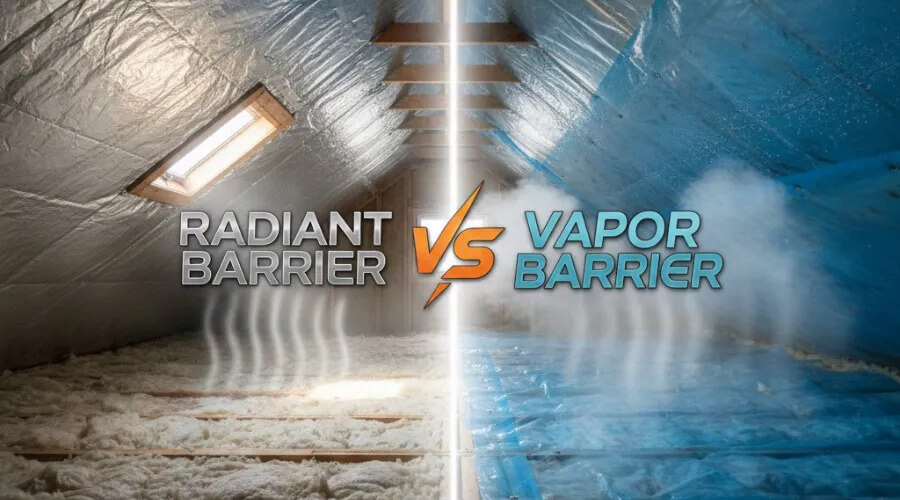
Radiant Barrier vs Vapor Barrier: What Should I Use to Cover Ceiling Insulation?
Published on December 26, 2025 | By Attic Pro Care, Inc
Facing extreme heat and cold is already a challenge in summer and winter, respectively. What if these challenges are further worsened by humidity? What if there is mold, an infestation, and a stale smell inside the attic? These are the problems every homeowner wants to get rid of. The selection of insulation type matters in it, and there are some factors that have a major impact on it. Before we find out the solution, here is a debate to settle between the radiant barrier and the vapor barrier. Which one should you choose for your attic’s ceiling? We have simplified this comparison for you, which includes some additional tips.
Radiant Barriers for Ceiling Insulation
Let’s talk about radiant barriers first, which are lightweight foils that reflect radiant heat waves. When installing them on the ceiling, they prevent the radiant heat from entering the attic. As a result, the attic and the rest of the upper portion of a home remain cool in summer. At least it is way less hot than it would be if there were no radiant heat reflector. But when it comes to moisture prevention, you need to know how they work. Then you will be able to know if they can work against vapor or not.
Aluminum-Based Foil and Moisture Behavior
Radiant barriers are aluminum foils that prevent the heat waves by reflecting them back to the source. However, they can resist moisture at a medium level. Since they need space between the rafters or ceiling, that space allows airflow. Thus, the risk of moisture buildup drops a bit. If you want to reduce vapor buildup, you will need a window for the airflow. Also, some people use dehumidifiers to further support radiant barriers to prevent moisture, along with heat reflection.
Radiant Heat Reflection and Energy Efficiency
Again, the function of aluminum foil is to reflect radiant heat. Homes that have attics need these radiant barriers to reduce indoor temperature. If they don’t do that, there will be less efficiency of HVAC systems. The air conditioning system has to face more burden amid extreme heat that comes through radiant heat. The only way to reduce that heat is through aluminum foil.
There are single-sided and double-sided radiant barriers in the market. That makes a lot of difference because a double-sided radiant barrier can also provide benefits in winter. It prevents the warmth from escaping the home.
Since it is about moisture prevention, a simple or permeable radiant barrier might not be very efficient against vapor. Especially in homes where the vapor growth is high, either from outside or from inside, they can’t rely on them.
Best Climates and Conditions for Radiant Barriers
Places where the heat is extreme, and the vapor is medium, need radiant barriers. Aluminum foils can reflect the heat throughout the day to prevent temperature increase in the home. Also, the space between the foils and the rafters provides airflow to prevent moisture buildup. That means if someone lives in a dry and hot climate, they need simple radiant barriers to reduce the mild moisture.
Even a permeable foil can allow slight moisture to prevent mold buildup. If it completely blocks the moisture, there will be a slight risk of condensation. Likewise, one needs windows for the ventilation against condensation and infestation related to it.
When Radiant Barriers Are the Right Choice for Attic Ceilings
When it comes to radiant heat, a radiant barrier is one of the top solutions for that. But can it also work as a vapor barrier? Well, there are a few factors that affect the results. Some regions have vapor buildup from indoors, and some get this threat from outdoors. In winter, the vapors are caused by indoor heat reacting with the cold ceiling. So, the radiant barrier’s shiny side has to face the indoor area from where the vapor is rising. If the outdoors is the source of heat, usually in summer, the shiny side has to face outdoors to reflect the heat waves. As a result, the risk of vapor buildup is reduced.
Vapor Barriers for Ceiling Insulation
Then comes the vapor barrier, which is primarily a core solution against vapor buildup. Lots of threats like mold, pest infestation, and poor air quality take place because of condensation. That condensation occurs because of vapor. To block those vapors, these vapor barriers are installed. They can create a barrier between the hot and cold air to prevent vapor formation. That is why many homes install them to reduce risk like that. Here are all the features of it that will help you understand how it works.
Polyethylene (PE) as a Vapor Barrier Material
Plastic like PE is one of the most efficient vapor barriers. Therefore, PE films work the best to prevent water particles from passing through them. The moisture in indoor air can’t cause mold, and the same goes for moisture from outside. These PE films are sealed off completely with waterproof tapes. As a result, the mold doesn’t take place in attics, whether the vapors come from lower sections or from the outside. Sealing the attics with PE films ensures there is no condensation or pest infestation.
How Vapor Barriers Prevent Condensation and Mold
The function of a vapor barrier in an attic ceiling is to prevent the reaction between warm and cold air. The warm indoor air can’t react with the cold air coming from outside, and there will be no condensation. Installing PE films on the ceiling, walls, and ground of the attic prevents mold formation. Also, outdoor humidity can not pass through the PE films to enter the attic.
Can mold grow under a vapor barrier? Well, it can happen. To prevent that problem, you should choose semi-permeable PE films that allow only minor particles. Also, if you fail to seal off the attic, the gaps between the PE films can allow mold. You should fully block the air by using tapes on PE films from one end to another. If the humidity is too high, use a dehumidifier to prevent this problem.
Best Climates and Conditions for Vapor Barriers
Vapor barriers are suitable for humid conditions instead of preventing radiant heat. They can’t prevent the heat from entering the house, but they can prevent vapors. So, there are homes that exist in highly humid conditions, which means they need vapor barriers more than anything. These people don’t need radiant barriers or even fiberglass batts because neither option is very good against vapor. However, both insulation types have an anti-vapor option that can provide some protection against vapor, besides heat reduction. So, PE films or vapor barriers are the best choice for homes in humid and moderate weather where the risk of mold is high.
Attic and Crawl Space Applications for Vapor Barriers
Many people install vapor barriers in attics and also in crawl spaces. These are the places where the risk of mold is the highest. They get high moisture from vapors rising from the middle parts of a home. Bathrooms, kitchens, and similar places cause high moisture inside the home. That moisture can enter places where the cold air and hot air combine. However, if you use fiberglass insulation and then a vapor barrier on it
When You Should Not Use a Vapor Barrier
Places where the indoors are usually moist because of high usage of AC should not use vapor barriers. Encapsulating the place with vapor barriers will trap the moisture inside the home, and there will be bad consequences. You can expect mold, a dull odor, and bacterial growth inside the home. To prevent that problem, use something other than a vapor barrier. Keep the dry air flowing inside the home against mold growth. Prevent warm air from reacting with cold surfaces with thick PE films or moisture-retardant coats.
When Radiant Barriers Are Not the Right Solution
Radiant barriers are suitable for summer and hot regions. They are not a good choice for cold regions or places where one needs thick insulation. You can either combine them with fiberglass insulation to prevent warmth from exiting the walls. Radiant barriers are mostly suitable for dry and hot regions. They can reduce the load on the air conditioning system by preventing the radiant heat waves.
Do You Ever Need Both Radiant and Vapor Control?
Then there should be something that can prevent vapor and also reflect the heat waves. Something breathable or something really solid needs to be there that can prevent heat waves and condensation. So, there is a solution for that.
Solid Radiant Barriers: Combining Heat Reflection and Vapor Control
Solid radiant barriers can provide high efficiency against mold growth in ceiling insulation. They can provide a double advantage because they can reflect heat waves and block vapors. Here are the explanations that will further simplify the working process for you.
How Solid Radiant Barriers Reflect Heat and Block Vapor
Over 90% radiant heat can’t pass through the solid radiant barriers. That happens when the shiny side of aluminum foil reflects the heat waves. If the aluminum foils are impermeable, they can block the vapors from reacting with the cold floor of the attic. Thus, the heat waves will remain outside, and the vapors can’t pass through the foils. Also, there is an airflow between the foils and rafters. The space of around an inch left between the foils and the solid surface provides airflow. That airflow prevents moisture buildup. So, the solution is here.
Climate Versatility of Solid Radiant Barriers
It is suitable for hot, humid, and cold conditions. The only thing you need to be careful with is the shiny side of radiant barriers. Place the shiny side towards the place from where the heat will come. In summer, the heat comes from outside, while in winter, the heat comes from inside. Placing the shiny side towards the heat source will provide efficient results.
Supporting Performance with Ventilation and Dehumidification
If you want to further your advantage, do one last thing. Install a dehumidifier if the humidity is really high. Before that, you need to have proper air ventilation for the airflow between the radiant barriers and the ceiling. If the air ventilation is not enough, you can go ahead with a dehumidifier.
Final Takeaways: Choosing the Right Ceiling Insulation Strategy
It is not about which insulation type you choose, but more about other factors. The errors in the form of gaps and holes in the insulation setup cause the maximum risk of condensation. Also, poor ventilation inside the home causes more risk of condensation than the absence of an insulation system. Whether you choose radiant barriers or a vapor barrier, try to seal off every source that increases the condensation.
The leakage of heat that reacts with the cold ceiling is what you should focus on more. Besides, hire a professional insulation service because every home has different conditions. Professionals inspect the attic, and then they choose which insulation is best for that place.